Hidden among the rolling fields of corn and soy in Antelope county, Nebraska sit the Ashfall Fossil Beds. This unique death assemblage tells the story of a massive volcanic event that covered the American midwest in ash some 10 million years ago. The animals interred here represent the fauna that flocked to a savannah watering hole in the ash-choked aftermath of the Bruneau-Jarbidge event, an eruption of what we now call the Yellowstone supervolcano.

Much like the victims of Pompeii, many of the animals at Ashfall remain in the same position they died in. A herd of Teleoceras, a Miocene species of rhinoceros, sits on top of the carnage. Beneath them are the skeletons of smaller animals, including horses such as Protohippus and Neohippus and camelids like Procamelus, trampled by the Teleoceras herd as they came and went from the watering hole during their final days. Beneath the horses and camels lie the remains of birds and turtles, evidence of a cascade of death prompted by the ash that slowly suffocated and entombed them. (University of Nebraska 2020)
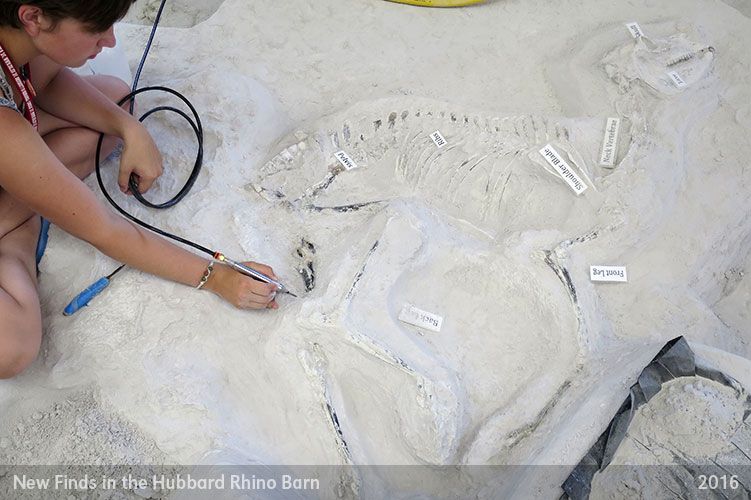
Some of the skeletons bear the marks of scavenging by a large, bone-crushing dog (possibly Epicyon), and some Teleoceras’ last meals are preserved in the ash that filled their empty ribcages. One even bears her fetus still curled in the safety of her bones, and many others lay down beside their calves (University of Nebraska 2020). These old bones, though, hold even more interesting evidence of their last days: pathology.
Most of the Teleoceras exhibit a specific type of bone pathology called hypertrophic osteoarthropathy (HOP) that is often linked with pulmonary dysfunction and trauma. That is to say that these animals show abnormal bone growth on the periosteum (smooth outer surface of the bone) of their limbs that is often seen in humans in relation to severe respiratory illnesses like tuberculosis or lung cancer. The presence of HOP indicates that these animals had been breathing in the volcanic ash for a long while, possibly for months, before they died, and suffered lesions or blockages of their lungs that resulted in this syndrome (M. Martinez-Lavin 2020).
Why does an illness of the lungs cause pathology in the bone? This is a question I have yet to find an answer to, but recent studies into HOP indicate that it may be related to the vascular system and oxygen distribution. Oxygen distribution would be impacted by lung damage, and might cause a cascade of consequences in the vascular system that would affect the extremities first. Regardless of the physiological mechanism behind the development of HOP, this particular bone condition is linked to pulmonary illnesses 90% of the time (M. Martinez-Lavin 2020).

If you visit this Pompeii of the midwest, keep in mind that the events preserved at Ashfall were not unique. The Ogallala Formation, which Ashfall is a part of, preserves multiple ash beds attributed to eruptions of the Yellowstone supervolcano throughout the Miocene. In fact, research is currently being done on the very sediment at Ashfall, as well as a number of other sites deposited during the Bruneau-Jarbidge eruption, to assess the potential human risk of a Yellowstone eruption in the future. This particular eruption occurred while the Yellowstone hotspot was beneath southern Idaho, and subsequent eruptions of the hotspot can be tracked to it’s modern-day home in northwestern Wyoming. At the time of the Bruneau-Jarbidge event, Ashfall sat at the farthest reaches of the ash cloud that blanketed the midwest following the eruption. (W.I. Rose et. al. 2003)
Sizes of ash particles and thickness of ash layers at Ashfall suggest that airborne ash was present in the environment for several months following the Bruneau-Jarbidge eruption. The thickness of ash layers vary from 40cm – 2m, which is thicker than expected for the region and prevailing winds. (W.I. Rose et. al. 2003) This could suggest that the eruption preserved at Ashfall was larger than the average eruption for Yellowstone, or may even preserve a change in prevailing winds following the eruption. Exactly what this means for the modern day is still up for debate, and may Yellowstone slumber beneath our feet for many years hence.
Citations
- Rose W., Riley C., Dartevelle S.. “Sizes and shapes of 10-Ma distal fall pyroclasts in the Ogallala Group, Nebraska.” Journal of Geology (2003). Vol 111:1, pp. 115-124.
- Martínez-Lavín M.. “Hypertrophic osteoarthropathy.” Best Practice and Research: Clinical Rheumatology (2020). Vol 34:3.
- “Ashfall Fossil Beds” University of Nebraska State Museum. University of Nebraska: Lincoln. Accessed 1/19/2021. https://ashfall.unl.edu/about-ashfall/


Leave a Reply