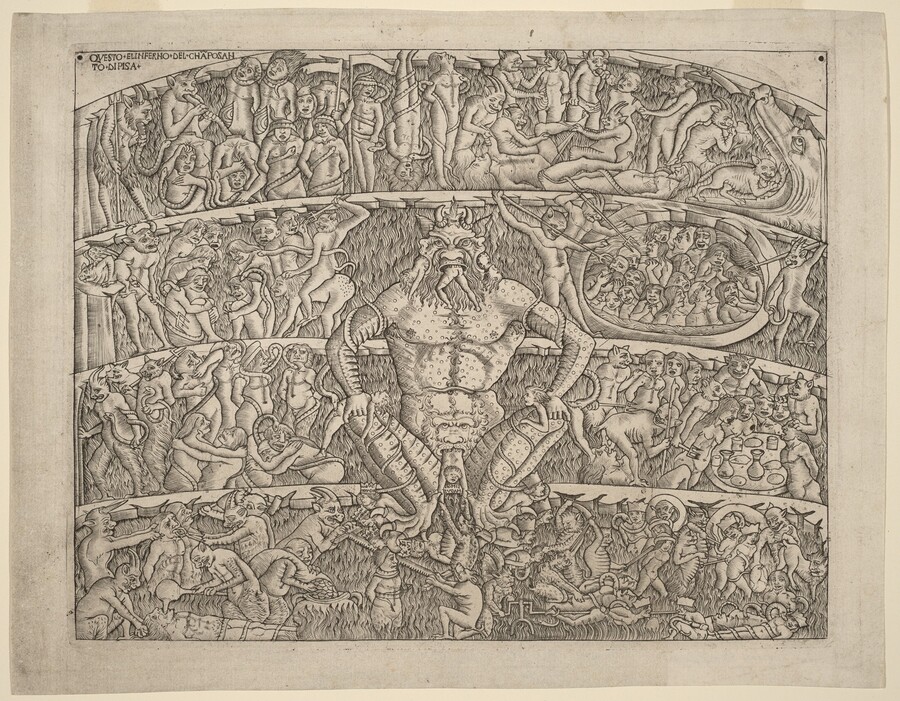
I often describe myself as pagan. I do this because it’s far quicker than explaining my actual views on religion and divinity as it exists within both the modern and ancient worlds and how those two things are connected with an intimacy that the vast majority of people will not honestly admit to. To me, divinity is a matryoshka. That is to say that divinity is nested upon multiple layers.
The first layer is the cosmos, the physical reality of the universe down to the smallest particles. It need not be observed, it simply is. It does not care about the things existing within it on any given planet, it is mostly void — vast spaces of nothing with unobserved marvels in between.
The second layer is the interpreter: the dog tracking smells through a neighborhood, the tree sending signals down its roots and feeding the forest around it. The worm at the whalefall, whose entire world is the single rib bone its slowly eating away. The human, chipping rocks into crude tools and following the herds of buffalo and mastodon across the savannah expanses of the world.
The third layer is the interpreted. The aspects of the cosmos as reflected in the eyes of the interpreter. The sky becomes the firmament, the movements of the planets gain consequence for the machinations of civilization, a thunderstorm is wrought in the image of man and father. It comes about when the interpreter measures and conceptualizes the vast unknown as something that knows them, can hear them, and by that measure can be manipulated by mortal means. It is the physical force reflected back in our own image.
And so, religion only exists by means of interpretation through the eyes of an interpreter. A god does not exist without something to worship it, a demon can’t wreak havoc without something that fears it. To the bone worm, the skeleton of the whale is God. To the gazelle, the leopard is a night stalking demon.
To the man, God creates and destroys. He carries weapons, sows fields, brings fire. A god loves, loses, wages war, grieves. God is just man in a funhouse mirror, which is not to say it isn’t real.
The first layer begets the second layer. Just because we are not endless uncaring void does not mean we aren’t real, it does mean we are bound by the laws set by that first layer. In the same way, the second layer begets the third: our spiritual beliefs are bound exclusively by the laws of our own interpretation. This does not mean gods and spirits aren’t real, aren’t powerful, aren’t capable of totally destroying someone against their will, it only means that they come from within the interpreter.
Take, for example, demons as depicted in western (ie. predominantly Christian) society. If it smells of sulfur and speaks liturgical latin, its almost certainly a demon. But why? Why would a demon speak the language of the first Catholic masses? By all means, liturgical latin is just another language — but it is often interpreted as a language of power now that its fallen out of common use. A curse written in latin is seen as more mysterious and powerful than the same curse translated to english. No one’s scared by someone laying a curse on your womb in english, but if I were to declare
PEREAT FRUCTUS VENTRIS TUI IN DILUVIO SANGUINIS
with enough conviction, you might be a tad bit freaked out.
The same question can be asked of sulfur. By all means, its an element. It has properties. It can be reactive. It has a smell. These are all facts, but present these to an interpreter with a desire to understand the world around them and you get a substance that smells of rot, that originates at the fiery tops of volcanoes and portals to the hellish underworld. Take this a bit further — if sulfur heralds the transit between the overworld and the underworld, would the smell not also herald the presence of something from that same underworld?
Then take a look at cultural crossover: the greek Hades and latin Pluton, lords of the underworld, become admixed with imagery of hell in our modern world. By all means, Hell isn’t even invented until well into the history of the judaic religions. Early translations of the bible (both new and old testament, not including Revelations) describe punishment for nonbelievers as a spiritual death — as stated in the KJV:
For the living know that they will die, but the dead know nothing; they have no further reward, and even the memory of them is forgotten. Their love, their hate and their jealousy have long since vanished; never again will they have a part in anything that happens under the sun.
– Ecclesiastes 9
Which is to say that Hell itself is a fear-mongering invention of the later church designed to keep people in line that neatly roped in concepts of the greek and latin underworlds and would later develop its own particular flavor as seen in the vibrant descriptions provided by Baptist, Pentecostal, Catholic, and other christian denominations.
Even the texts themselves, the dogma we base belief on, are seen entirely through the lens of interpretation. If you’ve ever attempted to research the mythology of particularly ancient cultures or cultures without their own form of writing, you’ve run into this yourself. Its impossible to find accounts of many celtic myths that aren’t tainted by the views of the christians or romans who initially encountered them. The more niche in scope you get, the more likely you are to encounter the issue of a native perspective becoming subsumed by the interpretation of a colonizing or annihilating force. See: Carthage. So the third matryoshka doll can only be experienced through the interpretation and understanding of the individual. The deeper down this rabbit hole you go, the less things make pure sense. There is no inherent logic, just thousands of perspectives each with their own merit and inherent truth that contradict the last thing you read. The more you try to make sense of it, the more you spiral into madness. You reach for that ineffable truth of the universe, feeling around in the dark, and sometimes your fingertips just barely brush something. Just enough to know that something is in that deep dark with you, but never enough to know just what that thing truly is.


Leave a Reply