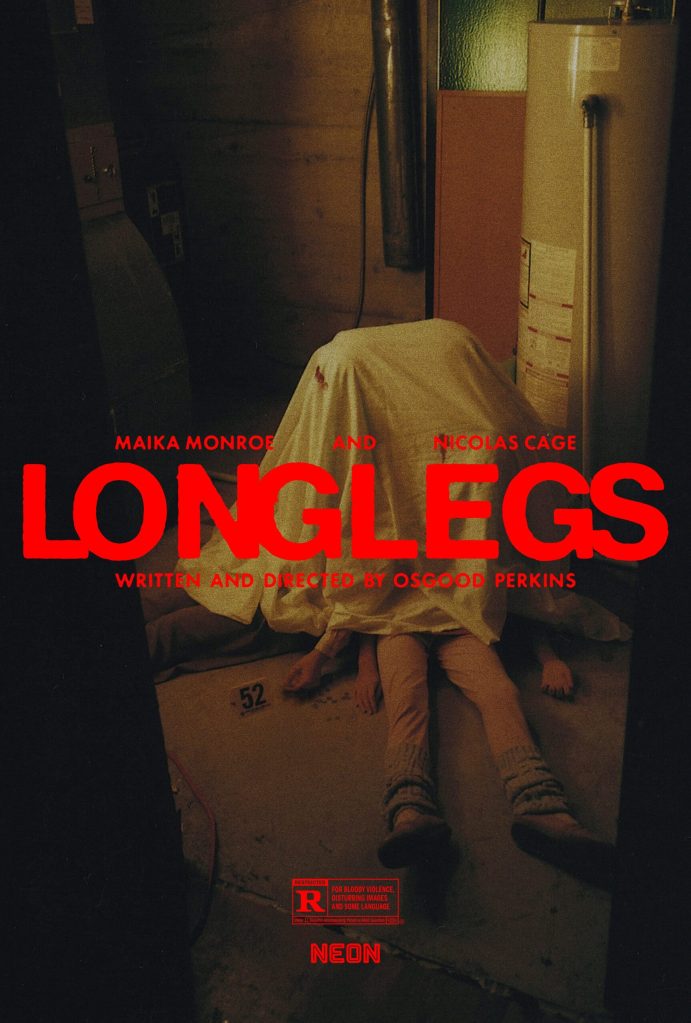
This is a review of Longlegs.
!!!Major spoilers for the entire movie ahead, reader beware!!!
There’s been an uptick in the amount of media featuring satanic concepts lately, some well-done and others lacking in nuance in a way that might have been fine in the 80’s, but grates nowadays. Longlegs is, unfortunately, in the “lacking nuance” category of satanic media.
Longlegs presents a disjointed cosmology to the viewer, methodically missing opportunities to give us a window into the practices that make Cobble a satanist and not just a serial killer with a supernatural edge. The beginning scenes imply the existence of a Project Stargate-like program, without ever using that concept again and instead haunting protagonist Lee Harker with the specter of the Devil Himself. The piety of Longlegs’ victims are emphasized, but the final victims don’t seem to be religious at all, throwing both motive and victimology into question.
Longlegs is not a long movie, and the best addition to the runtime would be a creative ritual sequence that emphasizes Cobble as artist. The movie tells us his dolls are porcelain, but not once are Cobble’s hands caked in clay. Not once does he hold a tool and carefully sculpt for us a visage of innocence in which to place the Devil. We are simply told that he does this — a crime in a visual medium. The complete lack of ritual depicted in this movie prompts a mental removal from the idea that these killings are satanic-lowercase-s, a genre that demands religious ritual of some variety. Consider the Exorcist: while we never see satanic ritual depicted, we get the ritual of Catholic exorcism in opposition to the supernatural force threatening the characters. The ritual exists either in support of or in opposition to the true enemy at hand. Satanic media relies on the use of ritual to further the story — a theme Longlegs ignores.
The movie likes to tell you that Longlegs has a ritual. “He’s making the sigil of Lucifer on the calendar,” it says, “he delivers death in the form of a doll he crafts with his hands,” it declares, but the aspect of the movie that feels most like ritual are Lee Harker’s calls to her mother, her sitting on the floor surrounded by evidence and methodically tracking through them day by day. Each of these actions are depicted intimately. Again, the movie fails the ritual aspect with Lee Harker in the first few scenes where she predicts the presence of a serial killer in a house, followed by an implication that she is psychic (a fact forgotten about 20 minutes into the movie). Despite her alleged psychic abilities, her success in cracking the case stems from Cobble himself providing her the information she needs to find him and not from her own “highly intuitive” capacity. Why does he do this? Who the fuck knows. Maybe the devil made him do it.
The depiction of the Devil is another sticking point: the depictions are disjointed. They had an opportunity for a subtle, creeping depiction of the devil in the doll as a mask of innocence, in the metal sphere as counterpoint to the pastoral families Longlegs likes to target and chthonic implication of metal as something torn from the bowels of the earth and worked by human hands. This would have been enough, but instead they opted for the obvious and haunted Lee Harker with the badly photoshopped shadow of Baphomet. They showed the doll’s true face through a black veil. They depicted the devil’s influence as writhing snakes in an eye-burning red filter, cheapening the symbolism they already constructed. It borders on camp, but Longlegs didn’t want to be camp, it wanted to be serious and creeping-crawling up your spine to leave you wide awake in the dark and, again, it failed.
None of the actors can decide what kind of movie this is either, which is a shame because many of the main performances are powerhouses in their own right. Nic Cage’s makeup and eccentric, loud behavior disrupts the quiet terror of the movie — he would have been flawless had they gone full camp with all the corn-syrup gore and caked on makeup they could pack into the flick. Maika Monroe’s subtlety, her toned down demeanor and relative emotionlessness lend a thoughtful quiet to her role that would have worked beautifully if they had kept the scares subtle, focused on what isn’t said instead of what is. Together, they represent the mismatch of Longlegs better than any clumsy depiction of satanism the film presents otherwise.
They filmed two movies here. One wants to be a campy insane romp through satanic murders, and the other wants to be a quietly terrifying supernatural thriller. They smashed these two together, and the result is something disjointed. Something I struggle to take seriously. It cannot be both camp and quiet-terror, but it tried anyway, and for that it suffers terribly.


Leave a Reply